
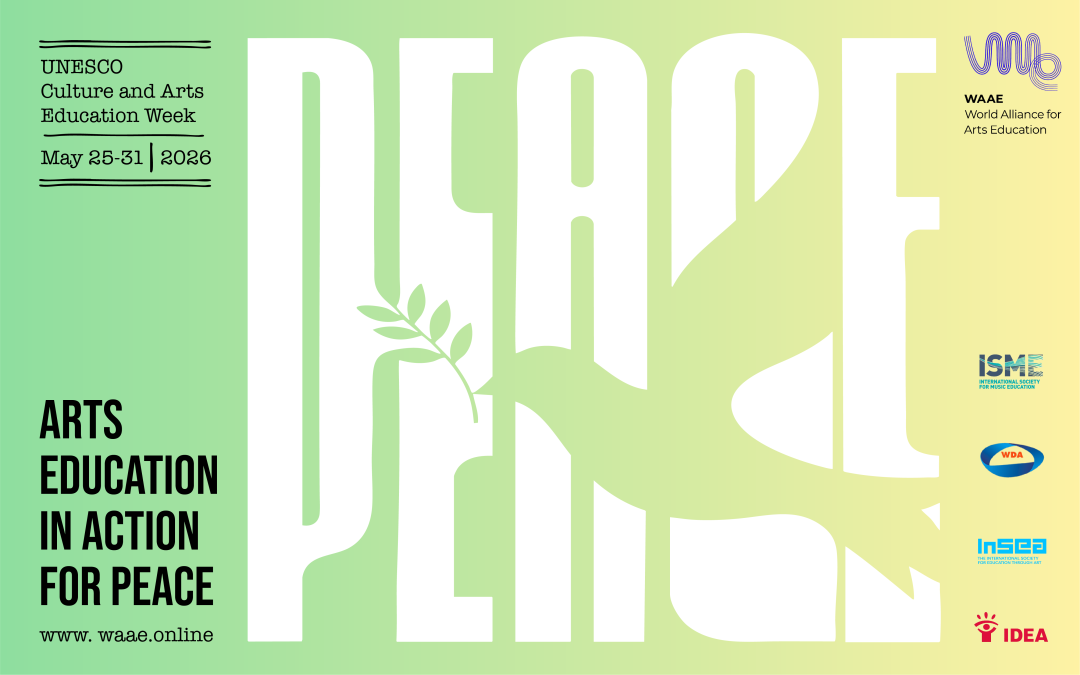
As part of UNESCO Culture and Arts Education Week 2026 (May 25–31), the World Alliance for Arts Education (WAAE) will host a series of international webinar panel discussions on the theme “Arts Education in Action for Peace.” Bringing together representatives and scholars from across the arts education communities, the sessions will explore how culture and arts education can foster empathy, creativity, dialogue, and more peaceful futures in times of global uncertainty and change. Panelists will share brief personal reflections on how they came to engage with questions of peace, followed by a moderated conversations and audience discussion.
Full program: https://www.waae.online/internationalcultureandartseducationweek2026.html
In response to this initiative, the International Drama/Theatre and Education Association (IDEA) will host an online gathering exploring how drama and theatre education can foster empathy, dialogue, social justice, sustainability, and peaceful engagement across communities and cultures.
Drama/Theatre Education in Action for Peace
Saturday, May 30, 2026 | 12:00 UTC
Registration Link: https://us02web.zoom.us/meeting/register/IsgXW2f1ThODb-OFxvIkXg
PROGRAMME
Peaceful Resolutions Through Drama and Dance
Michelle Gram Giesen
Abstract
This presentation explores how drama and movement can foster empathy, dialogue, and peaceful conflict resolution among young learners. Drawing from classroom practice with junior students in Toronto, Canada, the session uses the picture book What If Soldiers Fought with Pillows? by Heather Camlot as a catalyst for exploring imagination, courage, and nonviolent responses to conflict.
Through strategies such as tableau, movement sequences, writing in role, and improvisation, students engage deeply with themes of empathy, cooperation, and social responsibility. The presentation shares classroom reflections, student responses, and practical examples demonstrating how embodied and arts-based learning can create meaningful opportunities for dialogue and community-building. Participants will leave with adaptable strategies for educational and community contexts, and a deeper understanding of how drama and dance can support inclusion, global citizenship, and peaceful engagement.
Biography
Michelle Gram Giesen is an elementary educator with the Toronto District School Board, a Regional Coordinator and Board Member with the Council of Ontario Drama and Dance Educators (CODE), and the founder of Story Drama Suite. She facilitates workshops and presentations internationally on story drama, process drama, arts integration, and social-emotional learning.
Currents of Change: Exploring Climate Justice and Water Through Story, Movement and STEAM
Matthew Sheahan & Heather Newman
Abstract
Using the story We Are Water Protectors by Carole Lindstrom and Michaela Goade, this interactive workshop explores climate justice, sustainability, advocacy, and civic engagement through drama, movement, and language-based strategies. Participants will engage in practical activities designed to embody story, explore eco-justice issues, and imagine hopeful pathways toward a more sustainable future.
Led by members of the Council of Ontario Drama and Dance Educators (CODE), the workshop highlights participatory approaches that integrate Indigenous ways of knowing while avoiding cultural appropriation. Through collaborative problem-solving and embodied learning, participants will examine issues such as responsible resource extraction, ethical applications of AI, and environmental stewardship. Attendees will leave with practical strategies, inquiry-based project ideas, and resources for integrating climate justice and Indigenous perspectives into arts education.
Biography
Matthew Sheahan is Past President of the Council of Ontario Drama and Dance Educators (CODE), Vice President of the General Meeting Committee of IDEA, and Managing Editor of Provocations drama + dance Journal. He is an experienced drama educator and Indigenous Education Instructional Coach who has presented internationally on drama education, Indigenous perspectives, and inclusive arts practices.
Heather Newman is the North West Regional Coordinator for CODE and a drama educator in Northwestern Ontario. She has presented widely on drama and arts education, worked extensively in artist residency programmes, and contributed to theatre outreach initiatives supporting rural schools and communities.
Training the Intercultural Physical Body: Theatre Pedagogy from Workshop to Stage – Theatre as Conflict Resolution
You Lyu
Abstract
This presentation examines how intercultural theatre training can develop embodied awareness, empathy, and environmental responsibility among participants from diverse cultural and performance backgrounds. Drawing on the practice-as-research production Blind Bird, inspired by the extinction of the Great Auk, the project connects ecological awareness with theatre’s role in conflict resolution and anti-war expression.
Combining Chinese martial arts, Xiqu and Kung stylisation, Jacques Lecoq’s physical theatre practice, and touch-based improvisation, the pedagogy follows a five-step framework of teaching, improvisation, selection, refinement, and staging. Through physical engagement with ecological and conflict-based performance material, participants develop intercultural bodily vocabularies while exploring themes of conservation, ethics, and social responsibility. The presentation argues that intercultural theatre pedagogy can foster embodied empathy and provide transferable approaches for drama educators and community practitioners.
Biography
You Lyu is a PhD candidate in Drama and Theatre Arts at the University of Birmingham, specialising in intercultural physical theatre, performer training, and theatre pedagogy. His practice-led research combines Chinese martial arts, Xiqu stylisation, Jacques Lecoq’s physical theatre, and touch-based improvisation to explore inclusive intercultural learning and ecological performance.
#theatre.makes.politics – Theatre Education as Democratic Practice
Lutz Pickardt
Abstract
This presentation introduces #theatre.makes.politics, an Erasmus+ project coordinated by the German Federal Association of Theatre Education (BuT) between 2022 and 2025. Developed through international collaboration across Europe, the project responds to the rise of anti-democratic movements, including right-wing populism, extremism, disinformation, conspiracy theories, and religious fundamentalism.
The project resulted in a practical handbook offering methods and formats from cultural education and theatre pedagogy designed to strengthen democratic understanding, critical thinking, and intercultural dialogue among young people. Through theatre-based approaches, the project encourages participants to broaden perspectives, challenge prejudice, and engage constructively with people from different backgrounds and experiences. The presentation highlights how theatre education can function as a vital tool for democratic participation, empathy, and social cohesion in contemporary Europe.
Biography
Lutz Pickardt is a freelance theatre pedagogue and theatre director based in Kassel, Germany. From 2016 to 2023, he served as President of the German Association for Theatre Pedagogy. He specialises in physical theatre, Roy Hart voice work, and political education, and was the initiator and leader of the Erasmus+ project #theatre.makes.politics.
_________________________________________________________________________________
Haiku, Performance, and Theatre Education: Sensory Practices for Peace and Ecological Awareness
Roberson de Sousa Nunes
Abstract
This presentation explores haiku as a poetic and pedagogical framework for theatre education and scenic creation, connecting poetry, embodiment, and sensory experience. Drawing on postdoctoral research developed at the University of São Paulo (USP), with academic activities in Japan and China, the study investigates how haiku can foster creative processes, aesthetic perception, and ethical relationships with nature. Through performative practices based on movement, sound, silence, and collective theatrical games, haiku is approached as an embodied experience that values attentiveness, expressive synthesis, and listening. The presentation also reflects on the 2025 “Literary Voices” project at the Federal University of Minas Gerais (UFMG), developed with children aged 6–8 through literary and sensory education. The results suggest that the dialogue between haiku and performance offers a powerful model for artistic creation, ecological awareness, and peace-oriented theatre education.
Biography
Roberson de Sousa Nunes is Professor of Theater at the Pedagogical Center of the Federal University of Minas Gerais (UFMG) and holds a postdoctoral degree from the University of São Paulo (USP). His work focuses on interdisciplinary artistic practices, performance, literature, and sensory-based theatre education in Brazilian and global contexts.