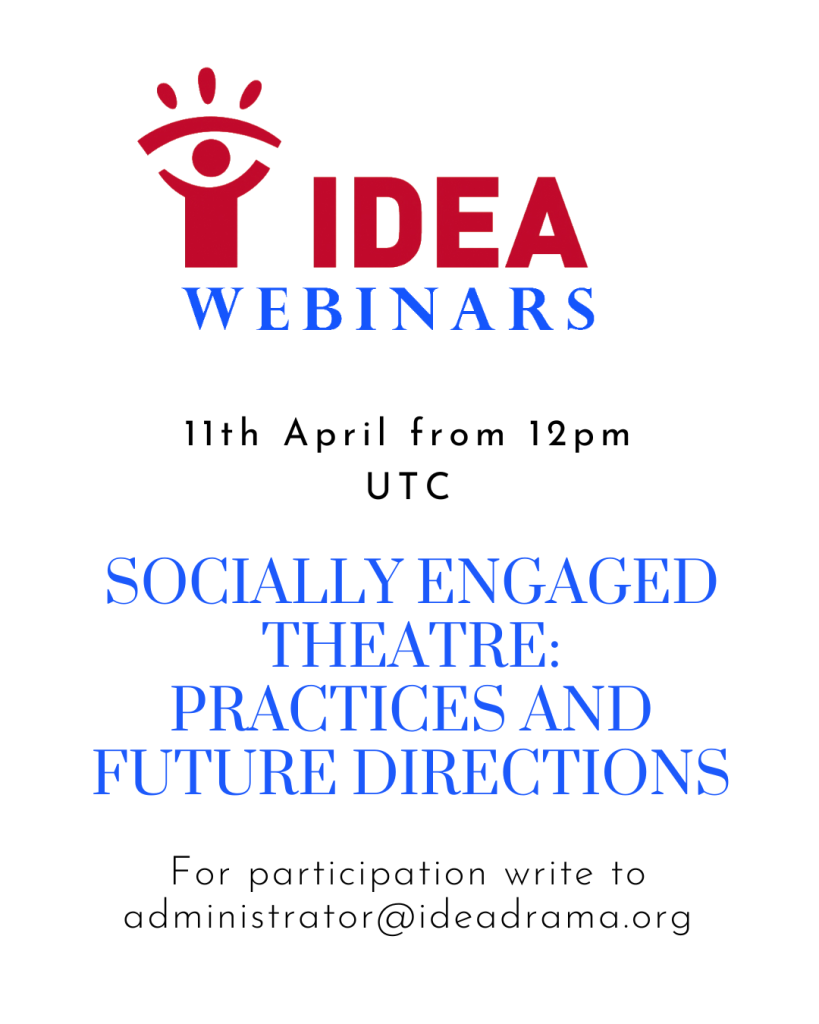
IDEA will be hosting a webinar Socially Engaged Theatre: Practices and Future Directions on 11th April 2026 from 12pm UTC.
This webinar explores socially engaged drama and theatre practices from around the world. Practitioners and researchers will share examples of the work they are doing today, the issues they address, and the communities they collaborate with. The conversation will focus on why socially engaged theatre matters in the current social and political climate, how artists approach this work in different contexts, and what possibilities they see for its future. The webinar invites participants to reflect on the evolving role of theatre as a space for dialogue, participation, and social change.
Presentations
Poliksena Hardalova & Sonia Barbosa (Portugal)
School of Education, Polytechnic University of Porto
Engaging and empowering Early School leavers through Theatre
This presentation shares the process behind the sensory performance Circumnavigate (2021), developed with early school leavers from the Second Chance School of Matosinhos (E2OM), Portugal. The project marked the 500th anniversary of Fernão de Magalhães’s voyage and was inspired by the writings of Antonio Pigafetta.
Created during the pandemic, the work explored new performative formats where small groups of spectators moved through a series of staged environments, experiencing a journey across time, space, and the senses. Rooted in sensory theatre practices—where the boundary between actor and audience dissolves—the piece invited participants into an immersive, co-created experience.
The presentation also reflects on sensory theatre as a pedagogical tool, highlighting its flexibility and its ability to bridge linguistic, social, and cultural divides, particularly in work with young people who have disengaged from formal education.
Bio- Poliksena Hardalova, PhD, is an actress, puppeteer, and drama teacher with over 30 years of experience in projects on inclusion, education, and civic engagement. She trains diverse groups using innovative, experiential methodologies. A graduate of NATFA Sofia, she works at the Polytechnic of Porto and researches at INET-md/CIPEM. Co-founder of the first Second Chance School in Portugal.
Sónia Barbosa is a doctoral student in Artistic Creation at the University of Aveiro, developing “The Artist Who Habits the Non-Artist.” Active since 2001, she explores theatre-education as a professor at the School of Education, Polytechnic of Porto, and as director of projects with non-artist collectives. Specialist in theatre and researcher at INET-md/CIPEM.
Lazar Jovanov (Serbia)
Challenging Ageism through Intergenerational Theatre
This presentation focuses on socially engaged theatre practices developed through long-term work with older adults and intergenerational groups in Serbia. Addressing themes of ageing, ageism, and dementia, the work combines applied theatre methodologies with community-based research and artistic production.
Implemented through international projects such as Age Against the Machine and Caravan of Solidarity, the approach is grounded in participatory methods that integrate personal memory, embodied expression, and collective dramaturgy.
Through performances like Forget Me Not! and Waiting for the Rain, created with intergenerational communities and involving people living with dementia and their caregivers, theatre becomes a space for dialogue, care, and increased social visibility. The presentation reflects on how such practices respond to ageing societies and open new directions for inclusive theatre-making.
Bio- Lazar Jovanov, PhD, is a cultural manager, researcher, actor/director, and project leader working in the field of socially engaged and participatory arts. He has extensive experience in designing and implementing international cultural projects focused on ageism, intergenerational dialogue, and community-based theatre, including EU-funded programmes across Europe.
Andrea Katrín Guðmundsdóttir (Iceland)
Minningaleikhús Theatre Company
Reminiscence theatre in Iceland.
Minningaleikhúsið was founded in 2019 as part of a Master’s project in Cultural Management at Bifröst University. It began as a drama course for older adults, culminating in a devised theatre performance in Mosfellsbær, and has since developed into an ongoing artistic initiative with several productions across Iceland.
The work is based on reminiscence theatre, a method that uses personal memories and life stories of older people as the foundation for creating and performing theatre. Both a creative and therapeutic practice, it aims to validate lived experience, foster intergenerational understanding, and create meaningful community engagement.
The presentation introduces the development of the project, including its most recent production in Egilsstaðir, and reflects on the importance of creating diverse and accessible artistic opportunities for an ageing population.
Bio- Andrea Katrín Guðmundsdóttir is an actress, director, and drama teacher. She holds a BA in Community Theatre from East 15 Acting School in England, and studied Cultural Management at Bifröst University in Iceland. She has taught drama to students of all ages. Currently based in Egilsstaðir, Iceland, Andrea teaches drama at the local elementary school while continuing to develop her theatre project, Minningaleikhúsið.’
Chetna Mehrotra (India)
Ranghbumi Applied Theatre
Facilitating Fragments: Toward a Dramaturgy of Emergence
This presentation explores theatre work situated at the intersection of socially engaged arts, participatory theatre, and practice-based research in India, particularly in collaboration with marginalized communities such as denotified tribes and migrant groups.
It introduces the concept of facilitative dramaturgy—an emergent methodology where facilitation itself becomes a dramaturgical practice shaping how narratives and performance material are created collectively.
Drawing on processes informed by Playback Theatre and Forum Theatre, and incorporating embodied mapping, storytelling, and improvisation, the work activates memory and lived experience within shared performance spaces. Through case studies, the presentation reflects on how these practices can challenge social hierarchies and contribute to evolving approaches in socially engaged theatre.
Bio- Chetna is a socially engaged arts practitioner working in the intersection of participatory theatre and facilitative dramaturgy. Her work examines how embodied experiences emerge, circulate, and translate into collective processes. She works with marginalized communities, schools, and organisations in India, engaging performance as inquiry into participation, power, and the conditions that structure collective action.
Shaq Koyok (Malaysia)
Awas Masas: A Puppetry Project for Indigenous Empowerment.
This presentation introduces Awas Mawas, a puppetry project developed with Indigenous communities in Malaysia. It addresses the impact of rapid technological and environmental change on vulnerable communities, particularly in relation to land rights and climate pressures.
The project uses collaborative storytelling and puppet-making—often with simple, eco-conscious materials such as cardboard—to create space for Indigenous voices and perspectives. It highlights how participatory art practices can support cultural expression, environmental awareness, and community empowerment.
Bio- Shaq Koyok is an award-winning Indigenous artist and activist from Malaysia. His art emphasises the inequalities that exist between modern consumer-based lifestyles and traditional sustainable ways of life. His works are a reflection of the people and the rainforest in which he grew up, and capture a contemporary view of the struggle faced by Malaysia’s indigenous people. He has exhibited all over the world, including la Biennale di Italia, Venice in 2022, and as an Artivist-in-residence with Artivist Network for COP28, Dubai, 2023 also Cop29, Baku, Azerbaijan, 2024 and COP30, Belem, Brazil.
Guillaume Gbekou (Togo)
Le théâtre au service de la jeunesse, de l’éducation et de la société
Guillaume GBEKOU est comédien, metteur en scène et directeur artistique du programme de formation en arts de la scène Je dois réussir. Il est aussi promoteur du festival Le Théâtre dans les Écoles et de La Nuit du Théâtre, rassemblant artistes et professionnels du théâtre, au niveau national et international.
Sa démarche artistique s’inscrit dans un théâtre engagé, nourri par les réalités sociales et politiques contemporaines. Il développe une écriture scénique inspirée du théâtre-partie, où musique et percussion accompagnent le spectacle du début à la fin, conférant à la scène une force rythmique et expressive particulière.
À travers ses créations, Guillaume GBEKOU fait du théâtre un espace de parole et de conscientisation. Il porte la voix des sans-voix, interroge les injustices et invite à une réflexion collective sur les enjeux de notre société. Pour lui, créer, c’est témoigner, questionner et transformer.
English
Theatre in Service of Youth Education and Society
Guillaume Gbekou is an actor, director, and artistic director working within a socially and politically engaged theatre practice. He is also the founder of initiatives such as Theatre in Schools and The Night of Theatre, which bring together artists and audiences across local and international contexts.
His work is rooted in contemporary social realities and often incorporates music and percussion as integral elements of performance, creating a strong rhythmic and symbolic theatrical language.
Through his practice, theatre becomes a space for expression, resistance, and awareness—giving voice to marginalized perspectives, questioning injustice, and encouraging collective reflection on societal challenges.
Matthew Sheahan (Canada)
Council of Ontario Drama and Dance Educators (CODE)
Reconciling the Future.
This presentation reflects on a site-specific theatre project developed in response to the Truth and Reconciliation Commission’s Calls to Action in Canada.
Focusing on Reconciling the Future, the work explores how non-Indigenous students can engage with shared histories through ethical and respectful creative processes. Developed in collaboration with an exhibition of Indigenous art, the project invited audiences to interact with both performance and visual art.
The presentation considers how theatre can support processes of reconciliation and decolonization, while avoiding appropriation and fostering meaningful dialogue.
Bio- Matthew Sheahan is Past President of the Council of Ontario Drama and Dance Educators (CODE) and Vice President of the International Drama/Theatre Educators Association (IDEA) General Meeting Committee. An experienced Drama teacher and OISE instructor, he champions Indigenous and marginalized voices, led the Grounded in Space and Place project, revised Ontario Drama/Dance curriculum, and is now an Indigenous Education Instructional Coach.
____________________________________________________________________________
If you want to participate as a listener, please contact administrator@ideadrama.org for the Zoom link.